
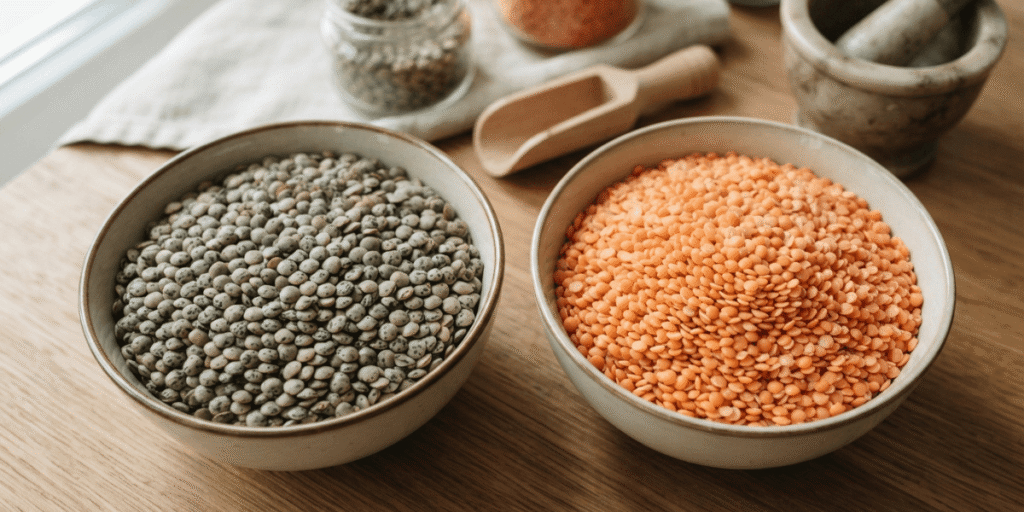
Food manufacturers rarely think twice about lentil color until a formulation fails in production. Red and green lentils look similar on a spec sheet, but they behave very differently once they hit a mixer, extruder, or cooking line. Green lentils hold their shape and carry a firm bite, while red lentils break down into a smooth, creamy texture within minutes. That single difference shapes which products each variety belongs in, from soups and grain bowls to purees, protein powders, and instant meal kits.
This guide compares red and green lentils across nutritional value, cooking behavior, and manufacturing applications, so buyers can confidently match the right variety to the right product line.
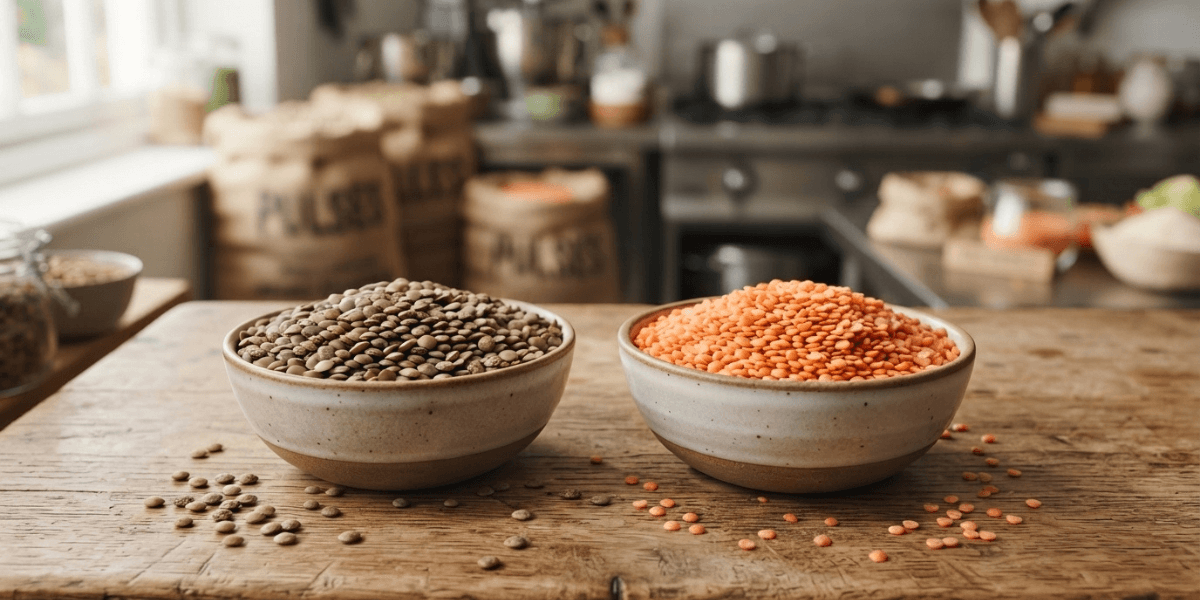
Green lentils keep their outer seed coat intact. They hold their shape after cooking and have a firm bite, making them useful in products where texture needs to stay visible, such as soups, grain bowls, and canned meals.
Red lentils are typically sold dehulled and split. Removing the husk speeds up cooking and produces a soft, creamy result once heated. This makes red lentils a common choice for purees, baby food, instant meal kits, and flour-based applications.
Neither variety is objectively better. The decision depends entirely on the texture and processing outcome a manufacturer needs.
Both lentil types are nutrient-dense, and the differences between them are small enough that neither should be marketed as significantly healthier than the other. Manufacturers making a claim-based decision should focus on red lentil protein content, cooking time, and processing yield rather than assuming one variety offers a nutritional advantage.
Green lentils carry a slightly higher protein percentage by dry weight compared to red lentils, though the gap is small enough that it rarely affects formulation decisions on its own.
Green lentils contain a bit more fiber than red lentils, mainly because the outer seed coat remains intact. Whole red lentils with the husk left on have a nutritional profile similar to that of green lentils.
Cooked red lentils run slightly lower in calories than cooked green lentils, though the difference is minor and unlikely to influence most product formulations.
Some research suggests that red lentils have a higher protein digestibility score than green lentils, meaning the body may absorb and use more of the protein they contain. This detail matters for manufacturers building high-protein or sports nutrition products.
Red lentils tend to carry a modest edge in iron content, while both varieties provide meaningful amounts of folate, magnesium, and potassium.
Both types of lentils are considered low-glycemic foods. Their fiber content slows sugar absorption, supporting products marketed for blood sugar management.
The table below summarizes the practical differences that matter most when choosing between the two varieties for a production line.
Attribute | Red Lentils | Green Lentils |
| Cooking time | 15 to 20 minutes | Up to 45 minutes |
| Texture after cooking | Soft, creamy | Firm, holds shape |
| Protein | High in plant protein | High in plant protein |
| Fiber by dry weight | Slightly lower | Slightly higher r |
| Best product fit | Soups, dals, dips, curries | Salads, side dishes, stews, veggie burgers |
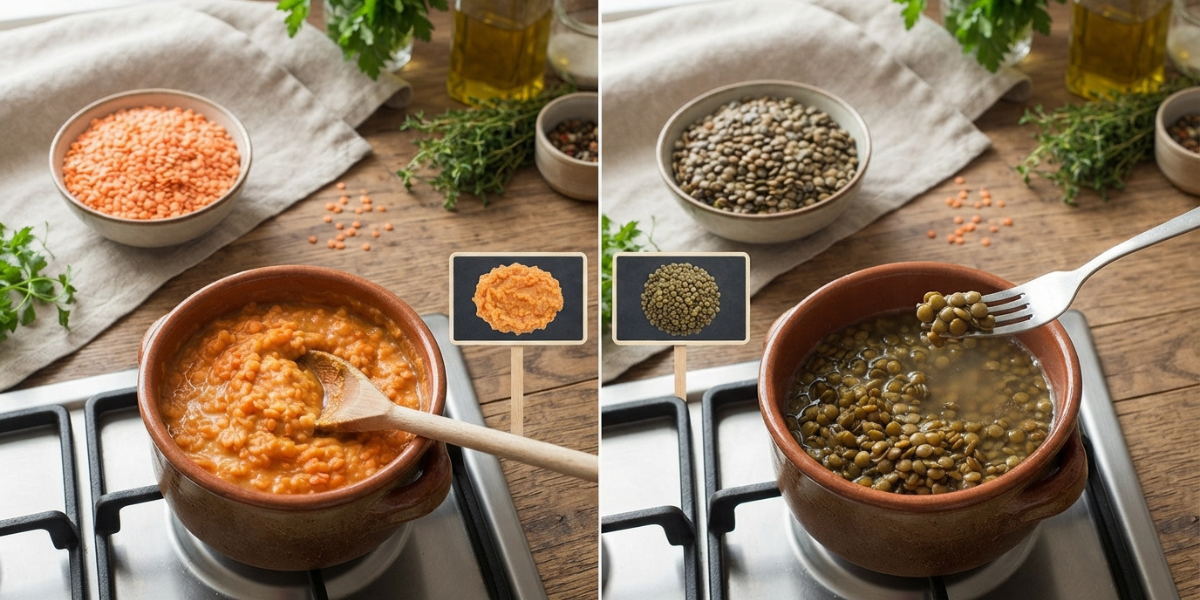
Cooking behavior often matters more to a manufacturer than the nutrition panel. Red lentils break down quickly, which reduces processing time and energy use in large-batch cooking operations. Green lentils resist breaking down, which makes them a better fit for products where the finished piece needs to remain visually intact.
Manufacturers producing dry mixes, soups, or canned goods should test both varieties under production conditions before locking in a formulation. Small differences in moisture content, grade, and origin can affect how each lentil performs once heated.
Beyond whole and split forms, lentils are increasingly processed into functional ingredients. Red lentil protein powder has gained attention for its neutral taste and light color, which allow it to blend into finished products without significantly altering flavor or appearance.
Common applications include:
Because red lentil protein has a milder taste than some other plant proteins, formulators often use it without heavy flavor masking, which simplifies product development.
Green lentils offer food manufacturers a versatile ingredient that can be used in both traditional products and newer plant-based formulations. Their mild, earthy flavor and firm structure make them suitable for applications where manufacturers want to add plant-based nutrition, texture, and fiber.
Common applications include:
For manufacturers developing lentil-based products at commercial scale, partnering with an experienced pulse supplier can help ensure consistent ingredient quality, reliable availability, and dependable specifications. These factors become especially important when green lentils are being incorporated into products that require consistent processing and repeatable production performance.
For brands looking to take pulse ingredients from sourcing through to finished products, American Harvest Group offers pulse co-packing services in the USA alongside scalable processing and packaging solutions. Our team can help streamline production while maintaining the consistency your product requires. Get in touch today to learn more!
A red vs green lentils decision should start with the finished product, not the ingredient itself. Manufacturers should ask what texture the product needs, how quickly the ingredient must cook at scale, and if the formulation calls for a protein-forward ingredient or a whole-food component.
Consider these factors before finalizing a sourcing decision:
The difference is minimal. Green lentils carry a slightly higher protein percentage by dry weight, though red lentils are often noted for a higher protein digestibility score.
Red lentils cook faster, typically within 15 to 20 minutes, because they are sold dehulled and split. Green lentils take as long as 45 minutes to cook because of their intact seed coat.
Yes. Red lentils break down into a soft, smooth texture that works well for purees, instant meal kits, and flour-based products.
Red lentil protein is often used as a plant-based alternative to animal protein due to its neutral taste, light color, and functional properties across bars, beverages, and baked goods.
Pricing varies by region, grade, and processing method, not color alone. Dehulling and splitting add a modest cost to red lentils compared with whole green lentils.
Choosing between red and green lentils comes down to the product being built, not a simple nutrition comparison. Red lentils suit fast-cooking, smooth-texture applications and protein-forward formulations, while green lentils fit products that need visible structure and a firmer bite. Testing both under real production conditions remains the most reliable way to confirm the right fit.
Looking for a dependable bean and lentil supplier in North Dakota? American Harvest Group can support your sourcing needs with established supply relationships and processing capabilities. Connect with us to explore your options!

Divyaa Dharga is a contributor at American Harvest Group, specializing in industrial hemp, sustainable agriculture, and emerging biomaterials. With a strong interest in regenerative farming practices and the evolving global hemp economy, she creates research-driven content that helps readers understand cultivation methods, supply chain developments, and innovative applications of hemp-based products. Through in-depth articles and industry insights, Divyaa Dharga supports American Harvest Group’s mission to promote environmentally responsible and economically viable hemp solutions.
