
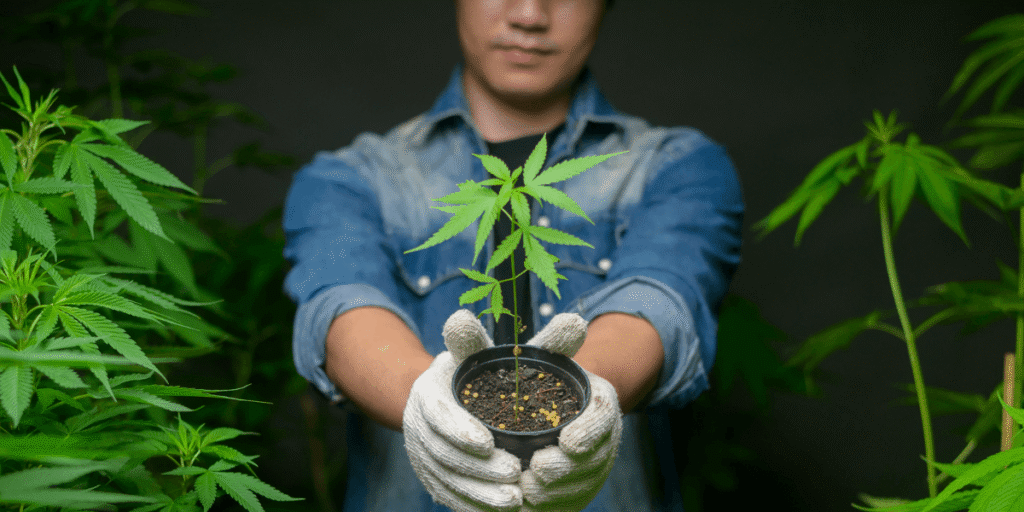
The United States has set a clear strategy to reach net-zero greenhouse gas emissions by 2050. Meeting that goal requires action across every major sector, including agriculture, construction, manufacturing, and energy. While much of the public conversation focuses on renewables and electric vehicles, industrial hemp is quietly emerging as one of the most practical and scalable contributors to the national climate agenda.
Its climate potential is increasingly supported by field research, lifecycle analysis, and emerging commercial applications. It is built on what this crop actually does in the field and what it delivers across the supply chain.
Some conventional cropping systems rely heavily on inputs and repeated tillage, both of which can contribute to soil carbon losses over time. Hemp can fit well within lower-input and regenerative farming systems, making it a crop worth serious attention in any national emissions reduction strategy.
Hemp offers fast growth, deep root systems, and broad industrial usage, positioning it as a meaningful agricultural response for greenhouse gas reduction while supporting both economic and ecological stability. It reaches maturity within a few months, producing dense stalks and leaves that actively absorb carbon dioxide throughout the growing cycle. Some of this captured carbon can remain stored in soils and long-lived products depending on how the harvested material is processed and used downstream.
Hemp carbon sequestration is one of the most discussed aspects of the crop’s climate value, and the research behind it is compelling. During its rapid 100 to 120 day growing cycle, hemp is recognized for its comparatively high biomass production and strong carbon uptake potential among annual crops. Some estimates suggest industrial hemp can sequester several tons of CO₂ per acre during a growing season, though figures vary depending on methodology, climate, and growing conditions.
Once captured, carbon does not remain solely in plant tissue. Some of that captured carbon can remain stored in fiber for insulation, textiles, and biocomposites; hurd for hempcrete, animal bedding, and soil amendments; and biochar, which functions as a stable carbon sink with both soil and industrial applications. Some of this captured carbon can remain stored in soils and long-lived products depending on how the harvested material is processed and used downstream.
Hemp roots can penetrate relatively deeply and may help support soil structure and organic matter levels under appropriate management conditions. Root biomass contributes directly to soil carbon pools, supporting longer-term soil carbon storage potential. This underground carbon storage also strengthens soil stability and reduces erosion risks, two outcomes that compound the climate benefit well beyond simple atmospheric drawdown.
Certain hemp-based materials, particularly hempcrete systems, may achieve low-carbon or potentially carbon-negative outcomes when evaluated across their full lifecycle. Whether any specific hemp product achieves that outcome depends on cultivation practices, processing energy, transportation, and end use, which is why lifecycle analysis matters in procurement decisions.
The U.S. Department of Agriculture committed over $3 billion through its Partnerships for Climate-Smart Commodities program to projects with measurable agricultural climate benefits. Hemp was included across multiple funded initiatives, reflecting institutional recognition of the crop’s potential within the USDA Climate Smart Agriculture framework.
Climate-smart agriculture focuses on productivity, adaptation, and emission reduction, and hemp can align well with all three objectives in many production systems. It adapts across diverse climates, requires fewer chemical inputs than many conventional crops, and delivers high-value outputs across multiple industries simultaneously.
Hemp often requires fewer pesticide inputs than many conventional commodity crops, although management needs vary by region and production system. Lower input use generally reduces the indirect emissions associated with chemical production and transportation, an often-overlooked component of the total agricultural carbon footprint.
Federal climate-smart agriculture funding priorities have shifted in recent years, creating some uncertainty for ongoing programs. Despite that, agribusinesses, food manufacturers, and industrial material producers that built supply chain infrastructure around hemp continue to expand. Commercial investment and private-sector interest continue to support expansion across segments of the hemp industry, advancing its progress.
Carbon farming in the USA has gained increasing attention as a framework that positions farmers as active participants in emissions reduction. Domestic agricultural supply networks, including those supporting crops such as flaxseed, barley, and hemp, are increasingly central to building the kind of resilient, lower-carbon supply chains that food manufacturers and industrial buyers now demand. Hemp fits this model through a set of clear, field-level outcomes:
Hemp sequesters carbon in soil, locks it into durable materials, can contribute to soil rehabilitation efforts in some farming systems, and substitutes for emissions-heavy industrial inputs across construction, manufacturing, and packaging. The case for hemp is supported by a growing body of agricultural and environmental research, and its commercial momentum is real. For agribusinesses, food manufacturers, and industrial buyers looking to integrate climate-smart sourcing into their operations, hemp is emerging as a credible and practical option.
American Harvest Group connects farmers with manufacturers, food companies, and wellness brands worldwide as a reliable flaxseed and barley supplier in the USA, helping businesses build climate-smart sourcing strategies grounded in real agricultural infrastructure.

Divyaa Dharga is a contributor at American Harvest Group, specializing in industrial hemp, sustainable agriculture, and emerging biomaterials. With a strong interest in regenerative farming practices and the evolving global hemp economy, she creates research-driven content that helps readers understand cultivation methods, supply chain developments, and innovative applications of hemp-based products. Through in-depth articles and industry insights, Divyaa Dharga supports American Harvest Group’s mission to promote environmentally responsible and economically viable hemp solutions.
